 Ispirato a questo saggio di Lea Melandri.
domenica 29 agosto 2010

sabato 28 agosto 2010
parmigiano reggiano (quando c'è si nota)
Per gli anni 2006, 2007 e 2008, il Consorzio del Parmigiano Reggiano ha ideato una divertente campagna pubblicitaria ispirata al genere musical. Qui lo spot completo delle varie versioni, compresa quella natalizia. I danzatori sono stati tramutati in ortaggi o pasta, la cui vita viene riaccesa dall'arrivo del Parmigiano Reggiano.
I costumi dei danzatori sono caratterizzati da imbottiture che limitano molto l'articolazione dei movimenti, anche se i colori vivaci rendono l'atmosfera allegra. La coreografia consiste in spostamenti minimi del busto, saltelli e giri. L'effetto coreografico viene dato principalmente dal fatto che questi movimenti vengono fatti in coppia o in gruppo. La scena è fatta di un pavimento a scacchi bianchi e rossi dove troneggia una gigantesca forma di parmigiano (da cui il sottotitolo della campagna), dalla quale escono dei buffi danzatori vestiti da scaglie con delle parrucche bionde in testa. La colonna sonora dello spot è la travolgente Mamma Maria (1982) dei Ricchi e Poveri, il cui testo è stato riadattato per l'occasione.
Il genere musical è da anni presente sul nostro territorio. Esso si caratterizza per la combinazione di varie arti quali la musica, il canto, la danza e la recitazione. La danza, di solito, ha un ruolo funzionale alla storia narrata e subalterno alla musica, come si evince da nomi di compositori famosi anche grazie al musical, quali George Gershwin e Andrew Lloyd Webber. Un musical difficilmente è noto per il coreografo o coreografa che ne ha curato le parti danzate, mentre spesso, appunto, viene ricordato per l'autore delle musiche o, eventualmente, della storia. Eppure, Cats (1981) non avrebbe probabilmente ottenuto il successo planetario che lo accompagna da decenni, senza le coreografie di Gillian Lynne. Così come West Side Story (1957) non si sarebbe impresso nella mente di molti senza le coreografie firmate da Jerome Robbins.
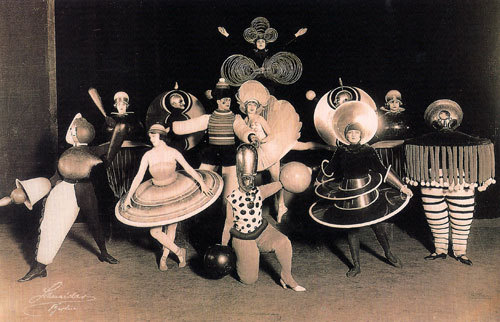
Per quanto concerne l'uso di costumi ingombranti, mi viene in mente il balletto ideato dallo scultore e pittore del Bauhaus, Oskar Schlemmer, Triadisches Ballet (1922) [balletto triadico], incentrato sul principio della trinità. Il balletto è infatti diviso in tre atti e consta di tre danzatori (due uomini e una donna), dodici scene e diciotto costumi. Questi ultimi si caratterizzano per le forme geometriche che trasformano la figura umana in un disegno astratto. Furono i primi ad essere concepiti, poi venne la musica ed infine la danza. Qui, qui e qui delle foto. Qui un estratto video della ricostruzione del balletto.
(post riveduto e integrato il 10 settembre 2010)
I costumi dei danzatori sono caratterizzati da imbottiture che limitano molto l'articolazione dei movimenti, anche se i colori vivaci rendono l'atmosfera allegra. La coreografia consiste in spostamenti minimi del busto, saltelli e giri. L'effetto coreografico viene dato principalmente dal fatto che questi movimenti vengono fatti in coppia o in gruppo. La scena è fatta di un pavimento a scacchi bianchi e rossi dove troneggia una gigantesca forma di parmigiano (da cui il sottotitolo della campagna), dalla quale escono dei buffi danzatori vestiti da scaglie con delle parrucche bionde in testa. La colonna sonora dello spot è la travolgente Mamma Maria (1982) dei Ricchi e Poveri, il cui testo è stato riadattato per l'occasione.
Il genere musical è da anni presente sul nostro territorio. Esso si caratterizza per la combinazione di varie arti quali la musica, il canto, la danza e la recitazione. La danza, di solito, ha un ruolo funzionale alla storia narrata e subalterno alla musica, come si evince da nomi di compositori famosi anche grazie al musical, quali George Gershwin e Andrew Lloyd Webber. Un musical difficilmente è noto per il coreografo o coreografa che ne ha curato le parti danzate, mentre spesso, appunto, viene ricordato per l'autore delle musiche o, eventualmente, della storia. Eppure, Cats (1981) non avrebbe probabilmente ottenuto il successo planetario che lo accompagna da decenni, senza le coreografie di Gillian Lynne. Così come West Side Story (1957) non si sarebbe impresso nella mente di molti senza le coreografie firmate da Jerome Robbins.
Per quanto concerne l'uso di costumi ingombranti, mi viene in mente il balletto ideato dallo scultore e pittore del Bauhaus, Oskar Schlemmer, Triadisches Ballet (1922) [balletto triadico], incentrato sul principio della trinità. Il balletto è infatti diviso in tre atti e consta di tre danzatori (due uomini e una donna), dodici scene e diciotto costumi. Questi ultimi si caratterizzano per le forme geometriche che trasformano la figura umana in un disegno astratto. Furono i primi ad essere concepiti, poi venne la musica ed infine la danza. Qui, qui e qui delle foto. Qui un estratto video della ricostruzione del balletto.
(post riveduto e integrato il 10 settembre 2010)
venerdì 27 agosto 2010
surreal friends
SURREAL FRIENDS
Pallant House Gallery
Chichester, UK
June 19 – September 12
http://www.pallant.org.uk/home
Pallant House Gallery has org anised a beautiful exhibition dedicated to three women artists, Leonora Carrington, Remedios Varo and Kati Horna. Its title, Surreal Friends, refers to the fact that they developed their art in relation to Surrealism, to which they added a peculiar and enchanting perspective, and, most of all, to the fact that they were good friends. All of them, in fact, went through the trauma of war and exile. They were European (Carrington was English, Varo Spanish, Horna, Hungarian) who travelled to Mexico to escape from Nazism and Fascism.
The exhibition is a celebration of their sisterhood. As Joanna Moorhead has noted, their escape represented a kind of liberation from the bonds society had put on them. Carrington came from a good family who introduced her to king George V and expected her to have a suitable marriage; Varo was raised in a convent; and Horna had a poor and difficult childhood. In Mexico City, they were able to marry and, except for Varo, have children, according to their own way, precisely because “their new homes gave them the space and peace to deconstruct their previous, action-filled existences”. Of the three, Carrington is still alive and still living in that house where she used to meet her friends. Even though the exhibition is dedicated to them, it presents their work in separated rooms, thus maybe missing part of the point in bringing them together.
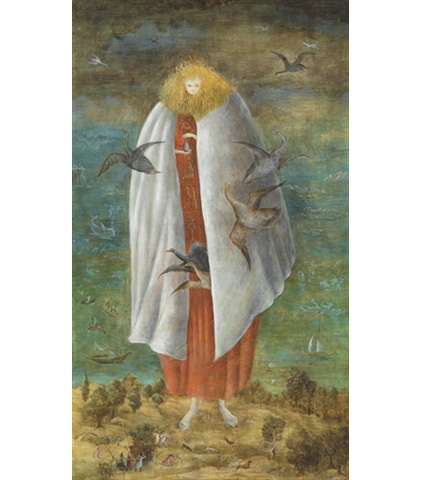
Carrington (1917) is possibly the most disturbing artist of the three. Her paintings are not always characterised by the same style and her imagination gives life to the most curious and unexpected shapes. There is often a sinister sense of awareness of what the subconscious can produce in her canvases. One of the most striking works is The Giantess, also called The Guardian of the Eggs (1950). It presents a fair haired woman with a small, almost childish face, and a strong-built body, that occupies almost all the painting. The colour of her hair is in contrast with that of her red dress and white cloak. Her tiny hands take care of a small egg, as if it were the most precious thing in the world. Then, the sinister touch: the giantess is surrounded by grey birds, two of which are coming out of her cloak. Are they her birds? Is she their guardian too? Maybe they are just her creatures. At her feet and behind her, other worlds are presented. A Lilliputian wood is populated by a group of people and numerous dogs. Both of them are running after a naked four winged female figure, who maybe inspired the fantastic six winged character from Carrington's novel The Hearing Trumpet:
…and we witnessed for a second an extraordinary creature. It shone with a bright light coming from its own body, the body of a human being entirely covered with glittering feathers and armless. Six great wings sprouted from its body and quivered ready for flight.
Behind the giantess, there is a sea of marvels, with boats, fish of many kinds and a whale. This powerful image is rooted in the Virgin’s iconography, but is much more assertive and self-aware. She does not look like a devoted mother, but rather as a sacred priestess. Her hair, for example, is not covered by any veil, but shines as the most luminous point in the painting. Other paintings displayed in the exhibition include, Green tea (or La Dame Ovale) dated 1942, characterised by a woman wrapped in a black and white fabric, surrounded by a garden with strangely shaped trees; and The House Opposite (La Maison En Face) (1945), a work where many female creatures run, prepare green-coloured potions and move between the different levels of the house they inhabit.
 Remedios Varo (1908-1963), is quite a different story. Her sign is more precise and filled with minute details, and her style remains quite consistent. However, as her friend, she was able to create imaginary worlds too. And she did so mainly following two recurring aspects: the repetition of a face with autobiographical traits and the invention of mechanical devices surrounding or containing her figures. In her intimate paintings, a figure, whose eyes especially recall those of Varo’s, recurs. According to Janet Kaplan, Varo’s “work is filled with self-portrait characters, but they are abstracted, metaphoric, ironic. Placed in a variety of situations (…) they become symbolic equivalents of the artist herself”. In Encounter (1959), a woman sits at a round table in a room. She is wrapped in a light blue set of fabrics that constitute the fluid, dynamic and chromatic quality of the work. Part of these fabrics reach a box on the table, a box the woman is opening. From inside the box her same face appears, as if to underline that the most important encounter we can have, is with ourselves. With regards to the mechanical devices, Varo learnt to draw them from her father who was a hydraulic engineer and often asked her to copy his drawings to keep her quiet when she was a child. In Spiral Transit (1962), Varo creates a fortified wall that develops according to a spiral shape and is filled with water. In its spiralling canals, strange machines, a mixture of wheeled and womb shaped boats, sail. Neither of them has an engine, but moves thanks to the wind or the work of its sailor. Other paintings included are the stunning Dragonfly Woman (1956-1958), where Varo’s masklike self-portrait is used to create an eerie figure, a woman-dragonfly filled with tiny translucent wings.
Kati Horna (1912-2000), was not a painter, but a photographer, and she is the less known of the three. She was a war photograph during the Spanish Civil War and became a portrait photographer in Mexico. As Joanna Moorhead has noted, “she is a master at using inanimate (if often human-related) objects – the doll, the mask, the puppet – to convey emotion and struggle and reality”. One witty example is Couple, Series, Fleamarkets of Paris, taken in 1934. It presents two cardboard figures, a man and a woman, standing one in front of the other, among other objects of the market, like a pair of shoes and a table. David Bate has argued that “the surreal is (…) a signifying effect (…) where a meaning is partially hidden, where the message appears ‘enigmatic’ regardless of how (…) it has been produced”. Horna’s photograph refers to the idea of a couple, presenting a man and a woman, but makes it enigmatic by choosing two cardboard figures to represent them. Horna also used the technique of collage and photomontage as it can be seen in The Aragón Front (1938), where the face of an aged man and of a kid behind him, is placed against the bare wall of a house destroyed by war. It is of great dramatic effect. Other stunning photographs showed in the exhibition, feature The Umbrellas (1937), where Horna’s camera captures from above a street filled with people with umbrellas, ; and Remedios Varo in a Mask by Leonora Carrington (1957), where Varo’s profile is framed by Carrington’s mask, made of a face surrounded by black lace. Emblematic and mocking, it is a tribute to the three artists’ friendship and art.
Pallant House Gallery
Chichester, UK
June 19 – September 12
http://www.pallant.org.uk/home
Pallant House Gallery has org
 anised a beautiful exhibition dedicated to three women artists, Leonora Carrington, Remedios Varo and Kati Horna. Its title, Surreal Friends, refers to the fact that they developed their art in relation to Surrealism, to which they added a peculiar and enchanting perspective, and, most of all, to the fact that they were good friends. All of them, in fact, went through the trauma of war and exile. They were European (Carrington was English, Varo Spanish, Horna, Hungarian) who travelled to Mexico to escape from Nazism and Fascism.
The exhibition is a celebration of their sisterhood. As Joanna Moorhead has noted, their escape represented a kind of liberation from the bonds society had put on them. Carrington came from a good family who introduced her to king George V and expected her to have a suitable marriage; Varo was raised in a convent; and Horna had a poor and difficult childhood. In Mexico City, they were able to marry and, except for Varo, have children, according to their own way, precisely because “their new homes gave them the space and peace to deconstruct their previous, action-filled existences”. Of the three, Carrington is still alive and still living in that house where she used to meet her friends. Even though the exhibition is dedicated to them, it presents their work in separated rooms, thus maybe missing part of the point in bringing them together.
Carrington (1917) is possibly the most disturbing artist of the three. Her paintings are not always characterised by the same style and her imagination gives life to the most curious and unexpected shapes. There is often a sinister sense of awareness of what the subconscious can produce in her canvases. One of the most striking works is The Giantess, also called The Guardian of the Eggs (1950). It presents a fair haired woman with a small, almost childish face, and a strong-built body, that occupies almost all the painting. The colour of her hair is in contrast with that of her red dress and white cloak. Her tiny hands take care of a small egg, as if it were the most precious thing in the world. Then, the sinister touch: the giantess is surrounded by grey birds, two of which are coming out of her cloak. Are they her birds? Is she their guardian too? Maybe they are just her creatures. At her feet and behind her, other worlds are presented. A Lilliputian wood is populated by a group of people and numerous dogs. Both of them are running after a naked four winged female figure, who maybe inspired the fantastic six winged character from Carrington's novel The Hearing Trumpet:
…and we witnessed for a second an extraordinary creature. It shone with a bright light coming from its own body, the body of a human being entirely covered with glittering feathers and armless. Six great wings sprouted from its body and quivered ready for flight.
Behind the giantess, there is a sea of marvels, with boats, fish of many kinds and a whale. This powerful image is rooted in the Virgin’s iconography, but is much more assertive and self-aware. She does not look like a devoted mother, but rather as a sacred priestess. Her hair, for example, is not covered by any veil, but shines as the most luminous point in the painting. Other paintings displayed in the exhibition include, Green tea (or La Dame Ovale) dated 1942, characterised by a woman wrapped in a black and white fabric, surrounded by a garden with strangely shaped trees; and The House Opposite (La Maison En Face) (1945), a work where many female creatures run, prepare green-coloured potions and move between the different levels of the house they inhabit.
 Remedios Varo (1908-1963), is quite a different story. Her sign is more precise and filled with minute details, and her style remains quite consistent. However, as her friend, she was able to create imaginary worlds too. And she did so mainly following two recurring aspects: the repetition of a face with autobiographical traits and the invention of mechanical devices surrounding or containing her figures. In her intimate paintings, a figure, whose eyes especially recall those of Varo’s, recurs. According to Janet Kaplan, Varo’s “work is filled with self-portrait characters, but they are abstracted, metaphoric, ironic. Placed in a variety of situations (…) they become symbolic equivalents of the artist herself”. In Encounter (1959), a woman sits at a round table in a room. She is wrapped in a light blue set of fabrics that constitute the fluid, dynamic and chromatic quality of the work. Part of these fabrics reach a box on the table, a box the woman is opening. From inside the box her same face appears, as if to underline that the most important encounter we can have, is with ourselves. With regards to the mechanical devices, Varo learnt to draw them from her father who was a hydraulic engineer and often asked her to copy his drawings to keep her quiet when she was a child. In Spiral Transit (1962), Varo creates a fortified wall that develops according to a spiral shape and is filled with water. In its spiralling canals, strange machines, a mixture of wheeled and womb shaped boats, sail. Neither of them has an engine, but moves thanks to the wind or the work of its sailor. Other paintings included are the stunning Dragonfly Woman (1956-1958), where Varo’s masklike self-portrait is used to create an eerie figure, a woman-dragonfly filled with tiny translucent wings.
Kati Horna (1912-2000), was not a painter, but a photographer, and she is the less known of the three. She was a war photograph during the Spanish Civil War and became a portrait photographer in Mexico. As Joanna Moorhead has noted, “she is a master at using inanimate (if often human-related) objects – the doll, the mask, the puppet – to convey emotion and struggle and reality”. One witty example is Couple, Series, Fleamarkets of Paris, taken in 1934. It presents two cardboard figures, a man and a woman, standing one in front of the other, among other objects of the market, like a pair of shoes and a table. David Bate has argued that “the surreal is (…) a signifying effect (…) where a meaning is partially hidden, where the message appears ‘enigmatic’ regardless of how (…) it has been produced”. Horna’s photograph refers to the idea of a couple, presenting a man and a woman, but makes it enigmatic by choosing two cardboard figures to represent them. Horna also used the technique of collage and photomontage as it can be seen in The Aragón Front (1938), where the face of an aged man and of a kid behind him, is placed against the bare wall of a house destroyed by war. It is of great dramatic effect. Other stunning photographs showed in the exhibition, feature The Umbrellas (1937), where Horna’s camera captures from above a street filled with people with umbrellas, ; and Remedios Varo in a Mask by Leonora Carrington (1957), where Varo’s profile is framed by Carrington’s mask, made of a face surrounded by black lace. Emblematic and mocking, it is a tribute to the three artists’ friendship and art.
martedì 24 agosto 2010






domenica 22 agosto 2010
l'erba voglio
Francia e Italia
vogliono trasformare i Rom
in una specie in via d'estinzione,
ma l'erba voglio
non esiste
neanche
nel giardino dei re!
vogliono trasformare i Rom
in una specie in via d'estinzione,
ma l'erba voglio
non esiste
neanche
nel giardino dei re!
sabato 21 agosto 2010
la danza fuori dalla scena (atti)
 E' uscito da qualche mese il volume, La danza fuori dalla scena - Cultura, media educazione (cliccare sul titolo per informazioni e ordini), frutto delle giornate di studio a Chieti, il 19 e 20 giugno 2009. Qui e qui due link. Il volume contiene il mio saggio, "Sulle tracce di Letter to the World: lo studio di una coreografia di Martha Graham fra ricostruzione e precarietà", dove analizzo la coreografia di Graham secondo una prospettiva metatestuale, indagando le problematiche inerenti la sua ricostruzione e la condizione di precarietà che ne ha costituito e ne costituisce il background. Sulla precarietà degli studiosi italiani ho creato una strisica a fumetti a cui ho dedicato un blog, The p.s. - la studiosa precaria, qui il link.
venerdì 20 agosto 2010
la scossa
La scossa è uno stacchetto di danza all'interno della trasmissione L'Eredità. Fu ideato da Amadeus (a quanto ha dichiarato lui in una puntata di Victor Victoria) e principalmente danzato dalla sua allora partner ed ora consorte Giovanna Civitillo, quando entrambi facevano parte del programma (dal 2002 alla primavera del 2006). Dall'autunno 2006, è condotto da Carlo Conti e da quattro ragazze sue assistenti, chiamate le professoresse. La scossa era una breve frase coreografica eseguita su di una musica ritmata, di solito una hit del momento o una canzone famosa. Ora è costituita dall'entrata in scena, completa di musica, di una delle professoresse, che accenna appena a qualche movimento.
I movimenti della scossa di Civitillo erano soprattutto movimenti delle braccia, torso e bacino, con una limitata articolazione delle gambe, presumo a causa dello spazio limitato in cui si muoveva. Civitillo inoltre eseguiva numerosi scatti con la testa, il cui effetto era potenziato dai capelli lunghi e sciolti. Qui un esempio in video. I costumi indossati da Civitillo erano disegnati in modo da esaltare il torso e il bacino, lasciando scoperte le gambe; ai piedi indossava delle scarpe col tacco. Le inquadrature della cinepresa di turno, di solito, erano dal basso verso l'alto in modo da sottolinearne le curve in modo alquanto esplicito (in questo video senza audio si rasenta la pornografia).
Gli stacchetti non presentavano una particolare invenzione coreografica, anzi tendevano a ripetersi con minime variazioni. L'interpretazione era piuttosto piatta, anche se i movimenti erano piuttosto seducenti ed energici. Civitillo danzava una caricatura della femme fatale che, nel contesto del gioco a quiz, diveniva grottesca: ella danzava in uno spazio circolare attorno al quale stavano i concorrenti; a volte utilizzava la struttura che ne segna il perimetro come sostegno per una mossa (come in questo caso); il conduttore e i concorenti, così come il pubblico, indossavano abiti comuni o eleganti, mentre Civitillo si presentava quasi nuda con abiti succinti, come se fosse in un night club.
Questo stacchetto andava in onda nella fascia preserale e, nel 2004, l'allora presidente Rai, Lucia Annunziata, lo criticò aspramente. Nella sopramenzionata puntata di Victor Victoria, Amadeus ha sottolineato la preparazione classica di Civitillo, quasi ad aggiungere una beffa alla sua immagine. Non importa essere diplomate in danza classica se poi in tv ti spogliano e ti fanno ancheggiare come una pornodiva. Interessante notare che, quasi per una legge del contrappasso, Victoria Cabello ha chiesto ad Amadeus di danzare una sua versione della scossa durante la trasmissione.
I movimenti della scossa di Civitillo erano soprattutto movimenti delle braccia, torso e bacino, con una limitata articolazione delle gambe, presumo a causa dello spazio limitato in cui si muoveva. Civitillo inoltre eseguiva numerosi scatti con la testa, il cui effetto era potenziato dai capelli lunghi e sciolti. Qui un esempio in video. I costumi indossati da Civitillo erano disegnati in modo da esaltare il torso e il bacino, lasciando scoperte le gambe; ai piedi indossava delle scarpe col tacco. Le inquadrature della cinepresa di turno, di solito, erano dal basso verso l'alto in modo da sottolinearne le curve in modo alquanto esplicito (in questo video senza audio si rasenta la pornografia).
Gli stacchetti non presentavano una particolare invenzione coreografica, anzi tendevano a ripetersi con minime variazioni. L'interpretazione era piuttosto piatta, anche se i movimenti erano piuttosto seducenti ed energici. Civitillo danzava una caricatura della femme fatale che, nel contesto del gioco a quiz, diveniva grottesca: ella danzava in uno spazio circolare attorno al quale stavano i concorrenti; a volte utilizzava la struttura che ne segna il perimetro come sostegno per una mossa (come in questo caso); il conduttore e i concorenti, così come il pubblico, indossavano abiti comuni o eleganti, mentre Civitillo si presentava quasi nuda con abiti succinti, come se fosse in un night club.
Questo stacchetto andava in onda nella fascia preserale e, nel 2004, l'allora presidente Rai, Lucia Annunziata, lo criticò aspramente. Nella sopramenzionata puntata di Victor Victoria, Amadeus ha sottolineato la preparazione classica di Civitillo, quasi ad aggiungere una beffa alla sua immagine. Non importa essere diplomate in danza classica se poi in tv ti spogliano e ti fanno ancheggiare come una pornodiva. Interessante notare che, quasi per una legge del contrappasso, Victoria Cabello ha chiesto ad Amadeus di danzare una sua versione della scossa durante la trasmissione.
Iscriviti a:
Post (Atom)